
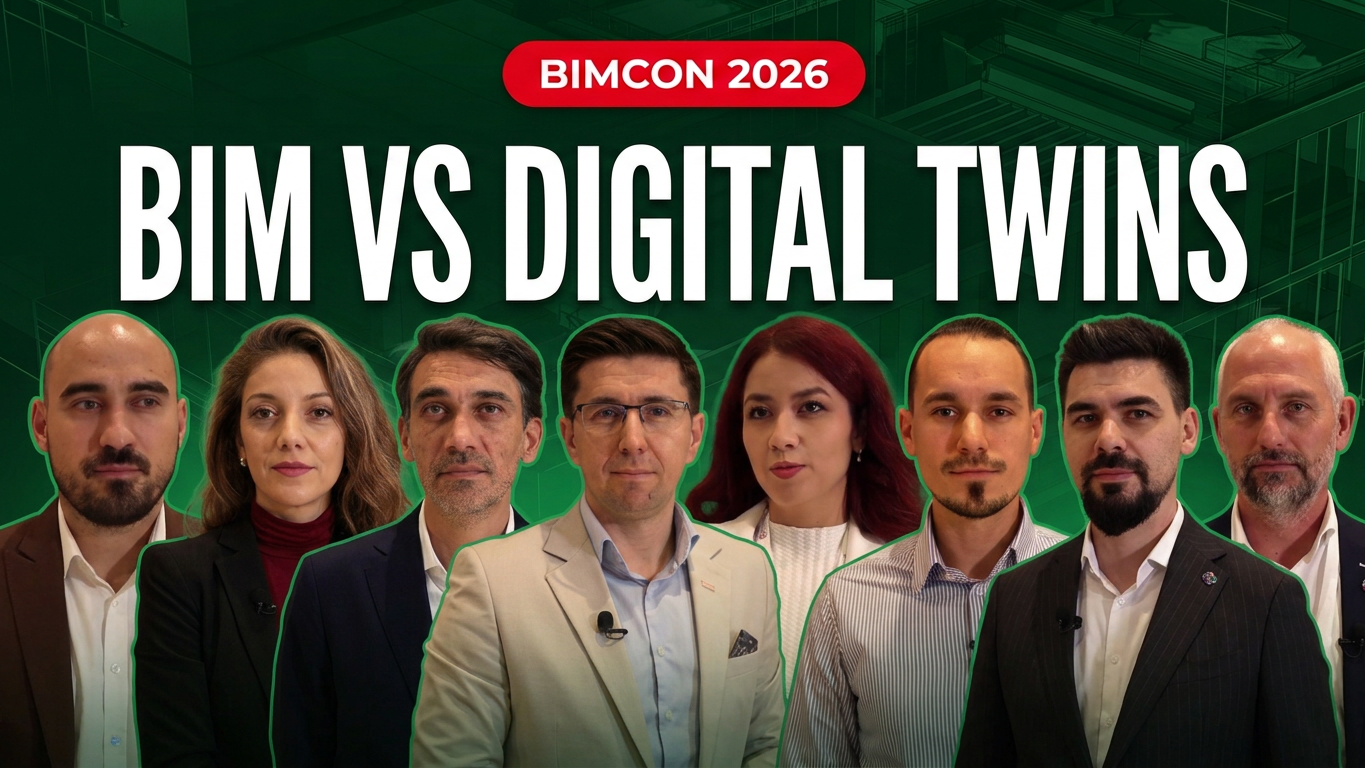
What do industry professionals really think about BIM and Digital Twins? And what misconceptions are holding the construction industry back?
At BIMcon 2026, DTVector brought its rapid-fire podcast format to the event floor, inviting architects, BIM specialists, researchers and industry leaders to share their perspectives on two important questions shaping the future of the built environment.
The special DTVector Rapid Fire episode at BIMcon 2026 brings together a diverse group of professionals from across the AEC industry. Our guests include Andrei Șueran, Managing Partner of Graphein; Cătălin Andrei, Head of BIM Management RO/MD at STRABAG; Oana Avram, Associate Technical Director | Principal Architect at Arcadis; Lex Ransijn, founder of VDCbase and openBIM community builder; Răzvan Grigorescu, Architect & BIM Specialist and Vice President for Development at buildingSMART Romania; Zhang Han-Lu Simona, Research Domain Leader at buildingSMART Romania; Stefan Constantinescu, architect and President of buildingSMART Romania; and Theodor Andrei Teaca, BIM & Automation Specialist.
The result? A series of honest, thought-provoking answers highlighting the need for better understanding, clearer definitions and a more collaborative approach to digital transformation.
🎥 Watch the full DTVector Rapid Fire episode from BIMcon 2026:
On this episode
We discuss:
- The biggest misconceptions surrounding BIM and Digital Twins.
- Why BIM should be understood as a process, not just a software solution.
- The difference between a BIM model, a digital replica and a Digital Twin.
- The importance of data, standards and information management.
- The human and organisational challenges behind digital transformation.
- Why ownership and long-term responsibility matter when developing Digital Twins.
1. BIM is a process, not just a software
One of the most frequently mentioned misconceptions was the idea that BIM is simply a type of software or a way to create 3D models.
Several participants pointed out that this narrow understanding overlooks what BIM actually represents: a collaborative process built around structured information, shared workflows and coordination between the different disciplines involved in a project.
BIM implementation is not just about choosing the right tool. It requires preparing teams, establishing processes and understanding how information should be created, managed and shared throughout a project’s lifecycle.
The discussion also highlighted a common confusion between BIM models and Digital Twins. Although closely connected, they are not interchangeable concepts.
A BIM model provides structured information about a built asset, while a Digital Twin goes further by connecting its digital representation with the physical asset and relevant information about its operation. Depending on its purpose and level of development, this can include sensor data, building management systems and other operational information.
Ultimately, the question is not simply how detailed a model can be, but how useful and connected its information really is.
2. What is holding back BIM and Digital Twin adoption?
When asked about the biggest barriers to wider adoption, participants identified several challenges that go beyond technology.
Standards and data management were among the concerns raised. Without clear standards and consistent information structures, connecting data from different sources and ensuring its long-term usability becomes difficult.
Cost and understanding of value were also mentioned. Clients may associate Digital Twins with expensive 3D models without fully understanding the potential benefits they can bring to building operations and maintenance.
But perhaps the most important barriers are organisational and human.
Participants highlighted resistance to change, limited knowledge, the need for investment and, above all, the question of ownership. Who is responsible for maintaining a Digital Twin? Who ensures that the digital information remains accurate as the physical asset changes?
A Digital Twin is not something that can simply be created and forgotten. Its value depends on the information behind it and the responsibility to keep that information relevant over time.
The discussion also brought attention to a fundamental aspect of digital transformation: technology alone cannot solve every problem. Successful implementation requires clear objectives, people who understand the process and organisations willing to adapt.
Beyond the buzzwords
The conversations at BIMcon 2026 revealed a common message: BIM and Digital Twins need to be understood beyond the technology and terminology surrounding them.
Their real value lies in the way information is structured, shared, maintained and used to support better decisions.
As the construction industry continues to evolve, education, collaboration and a shared understanding of these concepts will be essential to making digital transformation work in practice.
Graphein at BIMcon 2026
We were proud to be a partner of BIMcon 2026, an important meeting point for professionals and organisations shaping the future of BIM and the built environment.
Beyond the conversations captured in our DTVector Rapid Fire episode, we were also glad to contribute to the event’s discussions on BIM education and professional development.
Our colleague Anca Bulin, Key Account Manager at Graphein, joined the panel “Education and Certification: Practice What You Preach – PCERT Practitioner”, sharing her experience and highlighting the importance of developing practical BIM skills and supporting professional certification.
We believe that collaboration, education and knowledge-sharing are essential to advancing BIM adoption and strengthening the openBIM community.
About DT Vector
The DT Vector podcast is hosted by Eugen Ursu, co-owner of Graphein. A new episode is released every month, featuring conversations with experts shaping the future of real estate, construction, technology, and the built environment.
You can listen to all DT Vector episodes on:
Follow DT Vector wherever you listen to podcasts.